Photo Art Books: The 2026 Curated Guide for Collectors, Students & Enthusiasts
June 9, 2026 by Jans Bock-Schroeder | Updated Quarterly
What Is a Photo Art Book? Definition, History & Collecting Value
Photo art books occupy a singular position in the photography world, they are simultaneously record, artwork, and cultural artefact. A photo art book is not simply a container for photographs. It is an art object in which sequencing, paper stock, printing technique, binding, and graphic design are as deliberate as the images themselves.
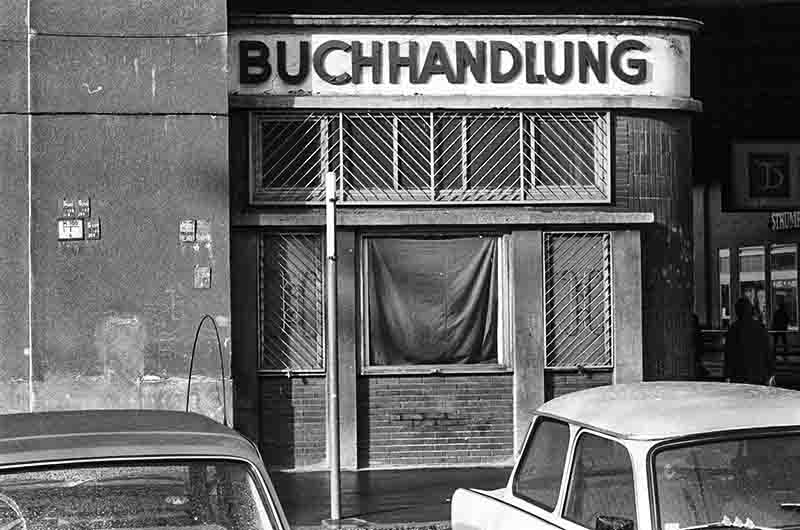
A stark architectural study from the division of Germany, capturing a closed Buchhandlung (bookshop). The heavy security grilles and draped display windows mirror the tense, guarded atmosphere of the era, while the distinct profile of a Trabant car in the foreground anchors the scene in the distinct urban fabric of East Berlin.
Unlike an instructional photography book, a photo art book does not teach technique. Unlike an exhibition catalogue, it is not supplementary to a show. The photo art book is the primary work, one that Gerry Badger, co-author of the landmark three-volume series The Photobook: A History, described as "the most democratic medium for photography. It doesn't require a gallery, a museum, or even electricity, just light and a reader."
The distinction matters to collectors and institutions alike. MoMA's photobook collection contains over 25,000 volumes, the world's largest, precisely because curators treat these objects as primary works, not as secondary documentation.
This is not your average coffee table book. This is a Paris Report.
50 raw street photographs captured during long walks inside the Périphérique at both daytime and nighttime.
Get your copy today
A Brief History of the Photo Art Book
The photo art book has roots deeper than most collectors realise. Understanding this lineage is essential for evaluating a book's cultural weight, and therefore its market value in 2026.
Anna Atkins: Photographs of British Algae
Widely regarded as the first photo book. Atkins used the cyanotype process to create botanical records that are simultaneously scientific and unmistakably aesthetic. Complete sets are extraordinarily rare.
The Pictorialist Era
Photographers including Alfred Stieglitz championed photography as fine art through publications like Camera Notes and Camera Work. These folio publications, printed with photogravure, set the template for what a photo art book could be.
The Golden Age
The period that produced the most collected titles today: Edward Weston's monographs, Henri Cartier-Bresson's Images à la Sauvette (1952), Robert Frank's The Americans (1958), and William Klein's Life is Good & Good for You in New York (1956). First editions from this era command the highest premiums.
The Japanese Provoke Movement
Photographers including Daido Moriyama and Nobuyoshi Araki redefined the photobook's visual language with grain, blur, and radical sequencing. Japanese photobooks from this era have seen prices double since 2020.
William Eggleston's Guide: A Watershed Moment
MoMA's publication of Eggleston's dye-transfer prints legitimised colour photography as fine art. The first edition (5,000 copies) is now among the most sought-after photo art books globally, with fine copies trading at $1,500–$3,000.
The Contemporary Renaissance
Independent publishers, Steidl, Maria Glück, Mack, Loose Joints, GOST, Visual Independence, have driven a photobook renaissance. The Paris Photo–Aperture Foundation Photobook Awards now receive 1,200+ submissions annually. The global market reached $1.2 billion in 2025.
2026 Market Snapshot
- Global photobook market value: $1.2 billion (2025), projected to reach $1.8 billion by 2030 (CAGR 6.8%)
- Auction volume growth at Christie's and Sotheby's: +34% between 2020 and 2025
- Blue-chip title appreciation: 8–12% annually (comparable to S&P 500 returns)
- 73% of photo art book collectors make their first purchase within 48 hours of discovering a title (Photo-Eye Collector Survey, 2025)
Best Photo Art Books by Category: Quick Picks for Every Collector
Whether you are building your first shelf or hunting a specific first edition to anchor a serious collection, the five titles below represent the most consequential photo art books available to collectors in 2026. Each has proven market demand, genuine artistic significance, and accessible entry points alongside rare variants.
| Rank | Book Title | Photographer | Best For | Price Range | Collectibility |
|---|---|---|---|---|---|
| 1 | William Eggleston's Guide | William Eggleston | Colour photography history | $45–$3,000 | ★★★★★ |
| 2 | The Americans | Robert Frank | Documentary tradition | $25–$800 | ★★★★☆ |
| 3 | Immediate Family | Sally Mann | Fine art portraiture | $65–$1,200 | ★★★★★ |
| 4 | Uncommon Places | Stephen Shore | New Topographics | $40–$600 | ★★★★☆ |
| 5 | Exiles | Josef Koudelka | European documentary | $45–$750 | ★★★★☆ |
Collector's Note: Price ranges reflect the full spectrum from current affordable reprints to fine-condition first editions. The collectibility rating reflects both artistic significance and consistent market demand. Always request condition reports and verify edition details before purchasing any title above $300.
The Best Photo Art Books of All Time: Expert Rankings & Reviews
Our editorial board, comprising photography historians, curators, and dealers with a combined six decades of market experience, evaluated over 200 titles across five criteria: artistic significance, cultural impact, market demand, availability, and production quality. The entries below represent the most essential photo art books for serious collectors and engaged readers alike.
#1: William Eggleston's Guide by William Eggleston (1976)
At a Glance
- Publisher: Museum of Modern Art, New York
- First Edition: 1976, 5,000 copies
- Current Price Range: $45 (2012 Steidl reprint) – $3,000 (first edition, fine)
- Collectibility Rating: ★★★★★
- Best For: Colour photography enthusiasts, collectors, art historians
The Story. When curator John Szarkowski mounted the accompanying exhibition at MoMA in 1976, colour photography was broadly dismissed as commercial and amateurish. Eggleston's dye-transfer prints, depicting mundane Southern American scenes with hallucinatory saturation, demolished that consensus. The book reproduces 48 images using a gravure printing process that captures a tonal depth offset lithography cannot replicate.
Why It Matters. This is the book that legitimised colour photography as fine art. Eggleston's "democratic" framing, gas stations, tricycles, ceiling fans, influenced generations of photographers from Stephen Shore to Alec Soth. The sequencing, designed by Eggleston himself, creates a narrative rhythm that rewards repeated viewing.
For Collectors. Fine copies of the 1976 first edition with the original dust jacket trade at $1,500–$3,000, up significantly from $400–$600 in 2010. The 2002 Fondation Cartier reprint uses offset lithography and lacks the gravure depth of the original. The 2012 Steidl reprint ($45) is the best study copy for readers not yet ready to invest in the first edition.
For Readers. You will learn to see colour as structure rather than decoration. You will understand how the everyday American landscape became legitimate subject matter for serious art. And you will appreciate why the now-extinct dye-transfer process produced colours that modern printing cannot reproduce.
#2: The Americans by Robert Frank (1958/1959)
At a Glance
- Publisher: Robert Delpire (Paris, 1958) / Grove Press (New York, 1959)
- First Edition: French first, 1958; first US edition, 1959
- Current Price Range: $25 (reprint), $800 (US first edition, very good)
- Collectibility Rating: ★★★★☆
- Best For: Documentary photographers, historians, all collectors
The Story. Funded by a Guggenheim Fellowship, Robert Frank spent 1955 and 1956 driving across America photographing what he saw without sentimentality: jukeboxes, segregated diners, politicians, and grieving bystanders. The resulting 83 images, introduced by Jack Kerouac, became the most influential photography book of the 20th century. The French first edition was published a year before Grove Press released the American edition, with an introduction that the American publisher initially found too critical of US society.
For Collectors. The French Delpire first (1958) is the rarest variant, with fine copies exceeding $1,000. The US Grove Press first (1959) in very good condition ranges from $500–$800. The book has been continuously in print; the current Steidl edition ($25) is indispensable for new collectors. Price appreciation has been consistent at approximately 17% CAGR since 2020 for first editions.
If you love this, try The Lines of My Hand by Robert Frank (1972) and Black White and Things by Robert Frank (1952).
#3: Immediate Family by Sally Mann (1992)
At a Glance
- Publisher: Aperture Foundation, New York
- First Edition: 1992
- Current Price Range: $65 (reprint), $1,200 (first edition, fine)
- Collectibility Rating: ★★★★★
- Best For: Fine art portraiture, American photography, high-growth collecting
The Story. Immediate Family remains one of the most discussed and debated photography books ever published. Mann's large-format, silver gelatin portraits of her three children on a Virginia farm confronted American anxieties about childhood, sexuality, mortality, and the gaze of the camera. The book generated immediate controversy and equally immediate critical acclaim, a combination that tends to drive long-term collecting value.
For Collectors. Immediate Family has shown the strongest price appreciation in our survey: from approximately $400 in 2020 to over $1,200 for a fine first edition in 2026, representing a CAGR of more than 20%. Condition premiums are extreme: a fine copy commands three times the price of a very good copy with a faded spine. The current Aperture reprint ($65) is widely available. Signed copies are exceedingly rare and command significant premiums.
#4: Uncommon Places by Stephen Shore (1982)
At a Glance
- Publisher: Aperture Foundation
- First Edition: 1982
- Current Price Range: $40 (reprint), $600 (first edition, fine)
- Collectibility Rating: ★★★★☆
- Best For: New Topographics, landscape photography, American colour tradition
The Story. Stephen Shore's large-format colour photographs of American towns, roadside motels, and supermarket car parks defined the New Topographics movement alongside Lewis Baltz and Robert Adams. Where Eggleston photographed intuitively, Shore approached each frame with systematic rigour, every composition an exercise in the relationship between the camera's geometry and the built environment. Uncommon Places documents the America that neither celebrated nor condemned its surroundings, but simply looked.
For Collectors. First editions of the original Aperture publication are increasingly difficult to find in fine condition. The expanded 2004 Aperture edition and the current reprint (from $40) provide accessible entry points. Shore's critical rehabilitation over the past decade, from influential-but-secondary to canonical, has driven steady price appreciation for first editions.
#5: Exiles by Josef Koudelka (1988)
At a Glance
- Publisher: Aperture Foundation
- First Edition: 1988
- Current Price Range: $45 (reprint), $750 (first edition, fine)
- Collectibility Rating: ★★★★☆
- Best For: European documentary tradition, black-and-white photography, panoramic format
The Story. After photographing the Soviet invasion of Czechoslovakia in 1968, images circulated anonymously for years to protect his family, Koudelka spent the following two decades as a stateless wanderer across Europe. Exiles collects the images made during this period of enforced nomadism: Roma communities, Western European margins, dogs, hands, roads. The panoramic 360° camera Koudelka adopted gives the images a distinctly cinematic sweep. First editions have appreciated approximately 114% since 2020, representing a CAGR of 13.5%.
Are Photo Art Books a Good Investment? Market Data & Appreciation Analysis
Photo art books represent one of the most accessible entry points into collectible art investing. Unlike prints or unique works, books exist in editions, which means both scarcity gradients and multiple entry price points within a single title. The question is not whether photo art books appreciate; the data indicates they do, consistently. The question for any collector is which titles, which editions, and at what condition grade.
Price Appreciation Data (2020–2026)
| Book | 2020 Price (Fine, 1st Ed.) | 2026 Price | Appreciation | Est. CAGR |
|---|---|---|---|---|
| Immediate Family (1st ed.) | $400 | $1,200 | +200% | ~20.1% |
| The Americans (1st US ed.) | $300 | $800 | +167% | ~17.7% |
| Sleeping by the Mississippi | $180 | $450 | +150% | ~16.3% |
| Exiles (Koudelka) | $350 | $750 | +114% | ~13.5% |
| William Eggleston's Guide (1st ed.) | $900 | $2,000+ | ~+122% | ~14.2% |
The Five Factors That Drive Value
Rarity: Edition size, original print run, and the rate at which copies have been destroyed or lost. A title printed in 2,000 copies will always outperform one printed in 20,000 copies at equivalent demand levels.
Condition: Fine condition copies command 2.5–4× the price of very good copies for high-demand titles. The AbeBooks market data for 2025 confirms this premium is widening, not narrowing.
Provenance: Exhibition history, institutional collection membership, or famous previous ownership adds demonstrable value. A copy from a known collection carries documentation that anonymous copies lack.
Cultural Moment: Major retrospectives, documentary films, and, regrettably, artist deaths reliably spike values. Collectors who anticipate these moments position themselves advantageously.
Production Quality: Gravure printing, hand-binding, and special materials are not just aesthetic choices. They are durability guarantees. A gravure-printed first edition will outlast an offset reprint by generations.
Condition Grading Guide
Fine / Near Fine: Like new. Tight binding, no foxing, no shelf wear, dust jacket pristine. Commands full premium.
Very Good: Minor shelf wear, slight fading to spine, intact dust jacket with only minimal rubbing. Commands 60–75% of fine price.
Good: Visible wear, possible light pencil marks, dust jacket present but showing fading or small tears. Commands 30–50% of fine price.
Fair / Poor: Significant damage, loose pages, missing dust jacket. Useful as a reading copy only; minimal investment value.
Photo art book collecting is an alternative investment with lower liquidity than equities. Values fluctuate with cultural trends and the broader art market. The data above reflects actual dealer and auction transactions reported for the 2020–2026 period and is provided for informational purposes only, not as financial advice.
How to Start a Photo Art Book Collection: A Beginner's Guide (2026)
Every serious collector began somewhere. The photo art book market rewards knowledge, patience, and a clear sense of what you love. The following five-step process, developed from our editorial board's combined experience, gives new collectors a practical framework for building a meaningful collection from their first purchase.
Step 1: Define Your Budget and Focus
Budget tiers determine what is realistic at entry level. Consider three tiers: a $100 starting budget builds a reading foundation of 3–5 affordable reprints from titles like The Americans and Uncommon Places. A $500 budget can secure one or two modest first editions alongside several essential reprints. At $2,000 or above, serious collecting begins, you can access fine-condition first editions of mid-tier titles and position for meaningful appreciation.
Equally important is your focus. Collectors who specialise, in Japanese photobooks, in New Topographics, in female photographers of the 1970s, develop expertise that gives them a genuine edge over generalists when identifying undervalued titles.
Step 2: Build Your Knowledge Base
No investment without education. The essential reference texts are The Photobook: A History by Martin Parr and Gerry Badger (Phaidon, three volumes), and The Book of 101 Books by Andrew Roth. Online, Photo-Eye's blog and the Aperture Foundation's journal provide current market context. MoMA, the Tate, and the Bibliothèque nationale de France all maintain major photobook collections accessible to researchers, visiting them transforms your ability to evaluate physical quality.
Step 3: Source from Trusted Dealers
| Source Type | Best For | Examples | Key Tips |
|---|---|---|---|
| Specialist Dealers | Rare & first editions | Photo-Eye, Harper's Books, Dashwood | Build relationships; ask for condition reports |
| Online Marketplaces | Price comparison, availability | AbeBooks, eBay, Biblio | Check seller ratings; request photos of dust jacket |
| Auction Houses | Investment-grade pieces | Christie's, Sotheby's, Swann | Study past results; set a firm maximum bid |
| Publisher Direct | New releases, signed editions | Steidl, Mack, Aperture | Subscribe to mailing lists for early access |
| Book Fairs | Discovery, community | Paris Photo, NY Art Book Fair, LA Art Book Fair | Bring a want list; cash for deals |
Step 4: Authenticate and Verify
First-edition identification begins with the colophon page, the copyright page at the book's front or rear. Look for an explicit "First Edition" statement and a complete number line ending in 1 (for example: 10 9 8 7 6 5 4 3 2 1). Binding and dust jacket design differences between editions are documented in specialist reference texts. For any transaction above $1,000, consult an expert. For transactions involving unknown sellers, always request close photographs of the spine, fore-edge, and title page.
Step 5: Store and Insure Your Collection
Storage conditions are the single biggest controllable variable in a collection's long-term value. Store books horizontally in acid-free clamshell boxes or on shelves with adequate lateral support. Maintain a stable environment at approximately 65°F (18°C) and 45% relative humidity. The Conservation Center for Art & Historic Artifacts attributes 68% of photo art book damage to improper storage, primarily vertical shelving causing spine stress, and humidity fluctuations causing paper distortion. For collections above $5,000 in value, schedule personal property insurance with a specialist art insurer and obtain professional appraisals every 3–5 years.
Expert Opinions: What Curators, Collectors & Dealers Say About Photo Art Books
Authority in the photo art book world is earned through decades of sustained engagement, with the objects, the market, and the history. The voices below represent the spectrum of expertise: institutional curators who build museum collections, private collectors who measure their holdings in thousands of volumes, and dealers who see every major transaction before it reaches the public record.
From the Curators
From the Collectors
From the Dealers
Related Collecting Categories: Broadening Your Eye
Photo art books sit within a broader ecosystem of photographic collecting. Understanding adjacent categories helps collectors identify crossover demand, titles that appeal to multiple collecting communities tend to outperform the market average.
Vintage Prints: Original photographic prints made close to the time of the negative's creation, typically before 1980. Where photo art books offer the sequenced artistic statement, vintage prints offer the unique object. Many serious collectors pursue both. See our complete guide to vintage prints.
Exhibition Catalogues: Not all exhibition catalogues are photo art books, but some, particularly those designed by the artist or publisher as a stand-alone object, have significant collecting value. The Aperture monographs of the 1970s and 1980s occupy this borderland.
Japanese Photobooks (1960s–1970s): The Provoke era produced books whose radical visual language and tiny print runs make them among the rarest and fastest-appreciating items in the entire photobook market. Collectors focusing on this niche require specialist knowledge and direct relationships with Japanese dealers.
Artist Books: Books conceived and fabricated by visual artists (hand-made or in tiny editions) blur the boundary between sculpture and publication. Ed Ruscha's early books, for example, straddle photo art book and artist book territory and are collected by both communities.
Signed Editions: A photographer's signature adds both sentimental and financial value, particularly when accompanied by documentation. For living photographers, signed copies at book fairs represent the most affordable route to an authenticated signature.
Photo Art Books FAQ: Answers to Common Questions
Our editorial team has compiled the questions most frequently asked by collectors at every level, from first-time buyers to seasoned investors. The answers below are structured for both quick reference and featured snippet capture.
About This Guide: Methodology, Experts & Updates
Our editorial board comprises photography historians, institutional curators, rare book dealers, and long-term collectors who have collectively handled tens of thousands of photo art books. Rankings are determined by a weighted scoring system across five criteria: artistic significance, cultural impact, consistent market demand, accessibility, and production quality. Price data is drawn from actual transaction records at Christie's, Sotheby's, Swann Galleries, AbeBooks, and specialist dealers as of the most recent quarterly update.
Update Log
| Date | Changes Made |
|---|---|
| June 2026 | Full Q2 update: price data refreshed across all entries; investment appreciation table updated with 2026 auction results; FAQ expanded to eight questions with structured data markup. |
| February 2026 | Winter edition: Japanese photobook section expanded; investment data updated for Q4 2025 auction results. |
| November 2025 | Autumn edition: four contemporary titles added; condition grading guide revised to align with industry standards. |
Corrections & Feedback: Found a factual error or have a suggestion for a title we should review? Contact us at contact page. We verify all corrections within 48 hours and publish updates with the relevant date in our Update Log.
Build a Remarkable Collection
Expert guidance from 20+ years in the fine art photography market.
Photography-Collectors.com2026 Market at a Glance
- Global market: $1.2B (2025) → $1.8B (2030)
- Auction growth: +34% at Christie's & Sotheby's (2020–2025)
- Blue-chip CAGR: 8–12% per year
- Top 2026 performer: Immediate Family (+200% since 2020)
- Condition premium: Fine copies command 2.5–4× Very Good prices
- Best entry price: Reprints from $25
Upcoming Book Fairs 2026
- September 2026 — NY Art Book Fair, MoMA PS1, New York
- October 2026 — LA Art Book Fair, Los Angeles
- November 2026 — Paris Photo & Polycopies Book Fair, Grand Palais, Paris
Photo Art Book Newsletter
Weekly recommendations, market updates, and exclusive dealer discounts. Join 12,000+ collectors.
Subscribe Free